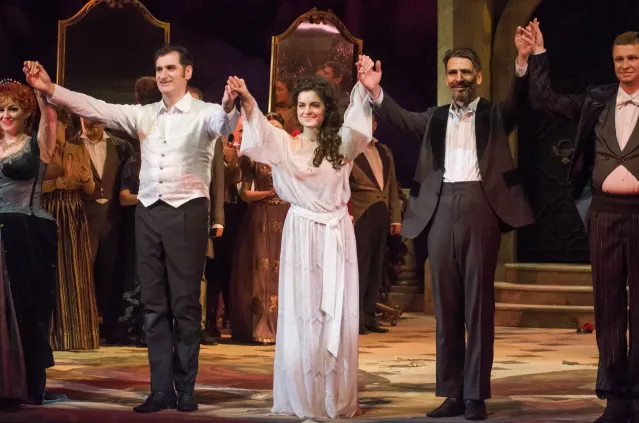
"Places, please!"
Rosalie stands alone in her dressing room, listening to the murmur of the audience beyond the walls. She takes a steadying breath, smooths her costume, then nods at her reflection, as if borrowing courage from the woman looking back.
She is 23, fresh from her MFA, and about to open her first leading role at a renowned repertory theatre.
Beneath her focus runs a quieter current, an anxiety so many performers carry in secret: What if I'm not enough? What if I don't belong?
When the curtain rises, she gives everything she has.
The night ends in uproarious applause. Flowers crowd her dressing room, tucked with notes from agents, family, and friends. She feels pride and disbelief, the fragile astonishment of a dream becoming real. Years of longing and sacrifice have culminated in this glittering moment.
The next morning, the reviews are published.
They are blunt. Cutting. Forever attached to her name.
Rosalie reads them in bed before her feet touch the floor. By day's end, she can recite the cruelest sentences more fluently than her own lines. As the season continues, she performs beneath the weight of perceived public failure. The openness she first carried onto the stage collapses under self-consciousness and dread.

An actress reads a negative review.
Source: Pheelings Media / iStock
When Critique Becomes a Verdict
For performers, the personal and professional are inseparable. Their voice, body, instinct, and imagination are the instruments of their trade. When a critic dismisses a performance, their words may land as an attack on the self. Psychologists call this ego threat: feedback that strikes at who we are, rather than what we have done.
article continues after advertisement
Ask any performer, and they can quote their worst review word for word, decades later. Almost no one can quote their best. Why?
Negativity bias. The brain registers negative information more powerfully than positive. An ancestor who flinched at the rustle in the grass was more likely to survive than one who remained cheerfully oblivious. Having once kept us alive, this survival instinct can now magnify a single criticism until it overshadows a season of standing ovations.
Contingent self-worth. Fine-tuning their craft through applause, laughter, and director's notes, artists learn early to anchor their value in external approval. With self-worth hinging on factors outside their control, every review can become a referendum on their right to belong. In a career defined by scarcity and instability, a single bad review can feel like a death knell for a precarious livelihood.
Rumination. Each rereading tells Rosalie's nervous system the threat is happening now. Social-evaluative threat activates the same stress circuitry as physical danger, shifting the brain into protective mode. We close down. We stop listening, stop creating, stop taking risks. Creativity requires openness. Threat demands self-protection. The two cannot share the stage.
Then there is the cruelty of permanence. Reviews once lined hamster cages by the weekend; now they are indexed and shared by algorithms. The spotlight effect offers some comfort: We overestimate how much others notice and remember our imperfections. Audiences move on far faster than we think, and are more forgiving, and more forgetful, of a scathing critique than the artist who carries it.
article continues after advertisement
Taking Back the Narrative
There are ways to soften the blow without abandoning the reasons you walked onstage in the first place. Performing, at its best, is an act of courage and generosity. We brave the spotlight so that strangers in the dark might recognize something of their own humanity in our work. The strategies that follow may help you protect what matters most: the work itself, and the part of you brave enough to keep making it.
- Decide how you'll engage before opening night. Reading reviews is a choice, not an obligation. Many performers never do; others wait until the run has closed. Harsh words lodge in memory, resurfacing at the worst possible moments: mid-scene, mid-line, mid-song. Protect your peace by setting boundaries in advance.
- Remember who did the work. A review evaluates one performance, on one night, filtered through one person's taste, history, and mood. Their response is shaped by their expectations and preexisting attitudes toward the genre, playwright, or company. Whatever they conclude, remember this: They did not do the creative work—the searching, collaboration, and laying bare of the self that brings a story to life. A review can be dashed off in a hotel room over a nightcap. You gave it your heart across weeks of rehearsal. Honour that.
- Say it out loud. Shame survives by convincing us we are uniquely defective and must keep quiet. Tell a trusted castmate, "That review gutted me," and notice how quickly "me too" comes back. Ask seasoned actors about their reviews. Google your favourite Broadway or Hollywood actors and read about theirs. You will be hard-pressed to find an artist who has not suffered bad press.
- Have a bad-review-off. Find the comedy in the cruelty and the absurdity in this strange corner of the profession. A scathing review does not exile you; it places you in a lineage of brave artists who were critiqued and carried on.
The Reviews Are Not the Final Word
Rosalie's story did not end with the morning papers. When she confided in an actress she admired, she discovered she was in good company. Then she turned back to what was still hers: the character, the story, the creative work.
She began to hold the review as a passing opinion, not a verdict on her value or a prophecy of her professional future. The critics' voices grew quieter. Before long, playfulness and awe returned.
Somewhere tonight, a performer stands in the wings with a critic's words still ringing in their ears. Still, they walk into the light.
Critics will have their say. But they do not get the final word. That belongs to the artists: the brave hearts who risk, reveal, and return, night after night.
Bravo.


